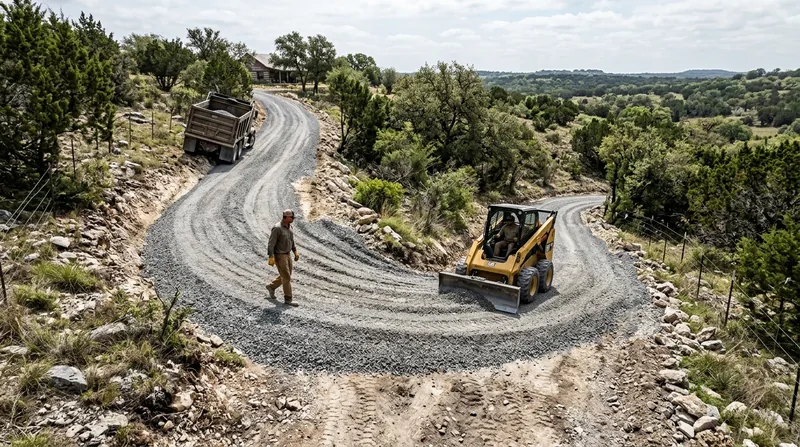




San Antonio's Hill Country fringe and northern suburbs sit on thin limestone and caliche where rock lies close to the surface, making gravel driveway installation and grading a practical choice for rural properties and ranch-style homes. Unlike the clay-heavy blackland prairie south and east of the city, where water pooling and expansion are the main problems, the limestone and caliche zones north and west of San Antonio face a different challenge: poor drainage over shallow soil and exposed rock. A properly graded gravel lane with compacted aggregate base sheds water fast, prevents erosion around the rock, and gives you a solid, all-weather surface without the cost of asphalt. We handle the full job, from base grading and pitch to compacted gravel installation, so water runs off instead of sitting on stone.
Why Gravel Driveway Grading Matters in San Antonio's Hill Country Properties
Gravel lanes and caliche roads are common on San Antonio's northern and western edge, where subdivisions and rural homes sit on former ranch land with limestone bedrock close to the surface. If you pour gravel on ungraded ground or over rock without proper pitch, water pools after a storm, softens the base, and washes gravel into low spots. Flash-flood storms are common in the Hill Country, and a drive that does not shed water fast will erode and develop ruts. Proper grading sets slope, compaction locks the aggregate in place, and good drainage keeps your lane stable year-round.
- We grade the base to proper pitch so storm water runs off instead of pooling on rock or soil.
- We compact the aggregate in lifts so gravel stays in place under vehicle traffic and does not migrate into low spots.
- We evaluate the existing ground and add or remove material to establish a stable, well-draining foundation.
- We lay the top course of compacted gravel for a finished surface that sheds water and resists rutting.
A well-graded and compacted gravel lane is the low-cost alternative to asphalt in rural and Hill Country properties, and it holds up when the base work is done right.
Key info: San Antonio's Hill Country subdivisions in areas like Boerne, Helotes, and Shavano Park often have caliche and limestone bedrock within 12 to 18 inches of the surface. Grading and compaction on this ground requires understanding how to work with rock and shallow soil. We know the terrain and the drainage patterns that work in these zones.
For more detail on driveway surfaces and alternatives, see our recycled asphalt and millings driveways page.
How We Grade and Install a Gravel Driveway in San Antonio: Our Process
Gravel driveway work starts with understanding the ground and the water flow. We visit the site, measure the length and width, check the existing slope and drainage, and identify any rock or soil conditions that affect the job. From there, we set the grade, do the excavation and grading work, compact the base, and lay the finished gravel surface. The whole process typically takes one to three days depending on the length of the drive and the ground conditions.
- We measure the driveway and evaluate the existing ground to understand slope, drainage, and soil type.
- We set proper pitch (typically 2 to 4 percent slope) so water sheds toward the sides or a low point.
- We grade and shape the subgrade, removing high spots and filling low spots to establish the base profile.
- We bring in compacted aggregate base material (crushed limestone, caliche, or recycled asphalt) and compact it in lifts.
- We lay the top course of gravel and compact it to a finished surface that resists rutting and sheds water.
The result is a stable, well-draining gravel surface that holds up in San Antonio's heat and heavy rain.
Example: A 200-foot driveway in Leon Valley with caliche bedrock at 14 inches required grading, removal of the high caliche, and a 4-inch compacted base of recycled asphalt topped with 2 inches of compacted gravel. The pitch was set to shed water toward the roadside. Total time on-site was two days, and the driveway now sheds storm water fast and has not rutted after six months of use.
If you are considering an asphalt surface instead, see our asphalt driveway paving page for comparison.
Gravel Driveway Installation Methods and Materials
| Approach | Description | Best for |
|---|---|---|
| Graded Gravel Base with Compacted Aggregate | We grade the subgrade to proper pitch, lay a compacted crushed limestone or recycled asphalt base (4 to 6 inches), and top it with 2 to 3 inches of compacted gravel. The aggregate is compacted in lifts to lock it in place. | Most Hill Country and rural San Antonio properties where water drainage is the priority and asphalt cost is not justified. |
| Recycled Asphalt Millings Base with Gravel Top | We use recycled asphalt millings (RAP) as the base layer because it compacts tight, binds with age, and sheds water. Gravel is laid on top for a finished appearance and additional wearing surface. | Drives where durability and compaction are critical and budget allows for a recycled asphalt layer. |
| Full Excavation and Regrading on Rock | On properties with caliche or limestone at or near the surface, we excavate, grade around the rock, compact the remaining soil, and lay base and gravel on the new profile. | Hill Country and Boerne-area properties where shallow bedrock must be worked around or removed. |
| Driveway Extension or Widening with Gravel | We extend or widen an existing gravel lane by grading the new area, compacting the base, and matching the existing surface height and material. | Properties adding parking or extending access where a gravel surface is already in use. |
Gravel Driveway Installation and Grading Cost in San Antonio: What to Expect
Gravel driveway pricing depends on the length and width of the drive, the condition of the existing ground, whether rock excavation is needed, and the type of materials you choose. A simple graded and gravel-topped lane on reasonably clear ground costs less than a full excavation and regrading job on caliche bedrock. We provide a written estimate with tonnage and material specs so you know exactly what you are paying for.
Several factors move the price up or down. A long driveway (300 feet or more) requires more material and labor. If caliche or limestone bedrock is present and needs to be worked around or removed, excavation time increases. If the existing ground is already well-drained and needs only grading and a gravel top, the cost is lower. Access (whether we can bring equipment close to the work) and the type of gravel or base material also affect the total.
For a detailed pricing breakdown and to understand what affects your specific job, visit our full pricing page. Call us at (210) 485-4679 for a free estimate, and we will measure your driveway and give you a firm quote with tonnage specs.
Gravel Driveway Installation and Grading Near Me: What San Antonio Homeowners Should Know When Hiring
Hiring the right contractor for gravel driveway work matters because poor grading and compaction lead to rutting, erosion, and washouts after the first heavy rain. A local contractor who understands San Antonio's terrain, drainage patterns, and the difference between Hill Country rock and blackland prairie soil is your best choice. Before you hire, verify that the contractor carries liability and property damage insurance, get at least two written estimates with material specs and tonnage, and ask for references from recent jobs in your area.
If your property is in a master-planned community or HOA, check the architectural guidelines to confirm that a gravel surface is allowed. Some HOAs restrict driveways to asphalt or concrete. If your driveway approaches the street or requires a culvert or curb cut, your city may require a permit and a utility locate (Texas 811) before work begins. San Antonio, Boerne, and other municipalities have different rules, so verify with your local building department before we start. We help you navigate the permitting process and will not begin work until all local requirements are clear.
For a free estimate and to discuss your specific situation, contact us online or call (210) 485-4679. We are local, fully insured, and ready to answer your questions about gravel driveway grading in San Antonio.
Gravel Driveway Installation & Grading in San Antonio: Pricing Guide
| Service | Price | Details |
|---|---|---|
| Basic Gravel Driveway Grading and Installation | Starting at $950 | Grading, compacted base, and gravel top on clear ground with good existing slope and drainage |
| Gravel Driveway with Recycled Asphalt Base | Starting at $1,400 | Grading, recycled asphalt millings compacted base layer, and gravel top for improved durability and compaction |
| Excavation and Regrading on Caliche or Rock | Starting at $1,800 | Full excavation around or removal of bedrock, regrading, compacted base, and gravel top on Hill Country properties |
| Driveway Extension or Widening with Gravel | Starting at $750 | Grading and gravel installation for added parking or extended access, matching existing surface and material |
| Complex or Large-Scale Job | On estimate | Drives over 300 feet, multiple utility conflicts, or significant soil or rock conditions require on-site measurement and evaluation |
| Free Estimate and Consultation | No charge | Written estimate with tonnage and material specs, response within 24 hours at (210) 485-4679, no obligation to book |
Indicative pricing, the exact cost depends on square footage, finish, and site access. Free personalized estimate within 24h at (210) 485-4679.


