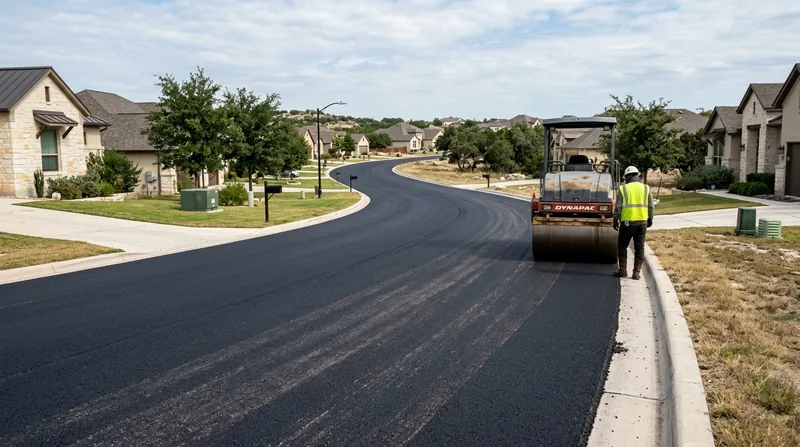




San Antonio's newer residential subdivisions sit on land that was ranch country just decades ago, and the ground beneath those HOA roads tells the story. Private Road & HOA Paving in San Antonio means building on mixed clay and caliche soils where the base is as important as the asphalt itself. North and west toward the Hill Country, thin limestone and caliche demand a foundation engineered to the ground beneath it. East and south toward Blackland Prairie, clay that swells after a storm and shrinks in a dry spell will crack a driveway built on an undersized base. We build hot mix asphalt over a compacted aggregate base matched to the subdivision's soil, then pitch the surface to shed water fast through San Antonio's sudden flash-flood storms and the triple-digit summers that soften asphalt if traffic sits loaded on it too long. The result is a private road or HOA drive that holds through the seasons and the years.
Why HOA Roads and Private Drives Fail in San Antonio: A Local Reality
Most HOA roads across San Antonio were paved between fifteen and thirty years ago, often over base materials that were adequate for lighter traffic and smaller vehicles. The ground itself has not changed, but the load has. Pickups, SUVs, and delivery trucks now roll over surfaces built for sedans and light domestic traffic. At the same time, the asphalt itself has aged: UV exposure, thermal cycling through San Antonio's temperature swings, and water infiltration into small cracks have made the surface brittle and prone to alligator cracking. When you see a checkerboard pattern of fine cracks across an HOA road, the base is failing, not just the surface.
- Thin or improperly compacted aggregate base allows the asphalt to flex and crack under vehicle weight.
- Poor drainage channels water under the pavement, where it weakens the base and accelerates failure.
- Clay soils that move seasonally can heave or subside unevenly, creating ruts and waves in the surface.
- Limestone and caliche require a thicker base and proper grading to prevent shallow settlement.
- Triple-digit San Antonio summers soften asphalt and allow loaded traffic to rut the surface permanently.
When an HOA road reaches this state, resurfacing alone will not hold because the base is compromised. A new layer of asphalt over a failed base is money thrown away.
Key info: HOA roads in Leon Valley, Castle Hills, and Alamo Heights built in the 1990s are now entering their third decade. Many sit on original bases never intended for today's vehicle weight and traffic patterns. A site visit and core sample tell the real story of what's underneath.
See our full explanation of asphalt resurfacing and overlay options to understand when a top layer is enough and when the base must be rebuilt.
How We Build HOA Roads and Private Drives to Last in San Antonio
Every HOA road and private drive we build starts with the ground. We grade and compact the native soil, then lay an aggregate base matched to what's beneath it. In Hill Country subdivisions near Boerne and Helotes, we build over caliche and limestone with a thicker, well-draining base to prevent shallow settlement. In Blackland Prairie areas east of San Antonio, we account for clay movement by ensuring proper pitch and subsurface drainage. Then we lay hot mix asphalt in lifts, compacting each layer to specification, and finish with a surface course designed to shed water fast and hold under San Antonio's heat and traffic.
- We measure the HOA road or private drive and verify soil conditions with test pits or boring.
- We grade and compact the subgrade, then lay and proof-roll the aggregate base to specification.
- We mill any existing failed pavement and remove it, or build over a stable existing base if it qualifies.
- We lay hot mix asphalt in lifts, compacting each layer to density and allowing proper cooling between lifts.
- We pitch the finished surface for drainage and verify thickness with cores before we leave the job.
The result is a road built to the ground it sits on, not a generic overlay that ignores the soil beneath.
Local example: A private road in Universal City serving eight homes had failed after twenty years because the original base was only three inches of recycled asphalt over native clay. We removed the failed surface, excavated to stable ground, laid six inches of compacted limestone base with proper drainage, then paved with three inches of hot mix. The road now carries the same traffic load and will last twenty-five to thirty years.
Learn more about our approach to milling and removal when we need to take out a failed surface before we rebuild.
Methods and Materials for HOA and Private Road Paving
| Approach | Description | Best for |
|---|---|---|
| Full-depth replacement | Remove failed pavement and base, excavate to stable soil, compact new base, lay new asphalt in lifts. | HOA roads and private drives where the base is compromised or undersized for current traffic. |
| Mill and overlay | Mill the top 1.5 to 2 inches of failed asphalt, recycle it, compact the existing base, lay new hot mix asphalt. | Private roads where the base is still sound but the surface is cracked or rutted. |
| Recycled asphalt base layer | Compact milled reclaimed asphalt as the base layer beneath new hot mix surface, reducing virgin material cost. | HOA roads where budget is a factor and the subgrade is stable enough to support a recycled base. |
| Grading and base prep | Excavate, grade, and compact native soil and aggregate base to proper slope and density before any paving. | New private roads or HOA drives built on undeveloped land or over failed foundations. |
Private Road and HOA Paving Cost in San Antonio: What to Expect
The cost of private road and HOA paving in San Antonio depends on the scope: whether you are resurfacing an existing road, rebuilding over a failed base, or paving a new drive on raw land. A full-depth replacement of a half-mile private road serving a small subdivision can run $40,000 to $80,000 or more, depending on soil conditions, existing pavement removal, and the thickness of base required. A shorter private drive or a mill-and-overlay job on a stable existing road will cost less. We provide a written estimate with tonnage and thickness specifications so you know exactly what is being delivered.
Factors that move the cost include soil type (clay requires different base prep than caliche), the condition and thickness of any existing pavement, drainage requirements, and whether we mill and recycle existing asphalt or remove it entirely. Access, utility locates, and any required municipal permits also factor into the final price. The best way to know your cost is to have us measure the road and assess the ground conditions on site.
Visit our pricing page for detailed breakdowns of typical HOA and private road jobs, and call us at (210) 485-4679 for a free estimate specific to your road and your soil.
Hiring a Paving Contractor Near San Antonio: What Matters Most
When you are ready to hire a contractor for an HOA road or private drive, verify that the contractor is insured and ask to see the certificate of insurance. Check references from other HOA communities or private road owners in the San Antonio area, and ask specifically whether the contractor delivered the tonnage and thickness promised on the estimate. Get at least two estimates so you can compare the base preparation, asphalt specifications, and finish details, not just the price. If your HOA has architectural standards or if the road touches the right-of-way, confirm with your HOA or the city that the contractor understands the permit and approval process.
Avoid contractors who offer a price without visiting the site, who demand a large cash deposit before the work begins, or who cannot provide a written estimate with tonnage and thickness. Honest paving work is quoted on site after measurement and soil assessment. Be wary of unsolicited door-to-door offers or crews with out-of-state plates who claim to have leftover asphalt from a nearby job. The strongest sign of a trustworthy local paving contractor is a local address and local references.
Ready to get started? Contact us for a free estimate and we will visit your HOA road or private drive, assess the conditions, and provide a detailed written quote with no obligation to book.
Private Road & HOA Paving in San Antonio: Pricing Guide
| Service | Price | Details |
|---|---|---|
| Private road or HOA drive resurfacing (mill and overlay) | Starting at $15,000 | Mill 1.5 to 2 inches of failed surface, compact base, lay new hot mix asphalt, typical for quarter-mile drives |
| Full-depth replacement (new base and surface) | Starting at $25,000 | Remove failed pavement and base, excavate, compact new aggregate base, lay new asphalt, cost rises with soil type and thickness |
| HOA subdivision road (half-mile or longer) | Starting at $40,000 | Full-depth build or overlay, grading and drainage, compacted base, multiple asphalt lifts, final cost depends on soil and access |
| Recycled asphalt base layer (cost offset) | Reduces full-depth cost by 15-25 percent | Milled reclaimed asphalt compacted as base layer, lowers virgin material expense when subgrade is stable and suitable |
| Estimate and site assessment | Free | We measure, assess soil, review drainage and existing conditions, provide written quote within 24 hours, call (210) 485-4679 |
Indicative pricing, the exact cost depends on square footage, finish, and site access. Free personalized estimate within 24h at (210) 485-4679.


