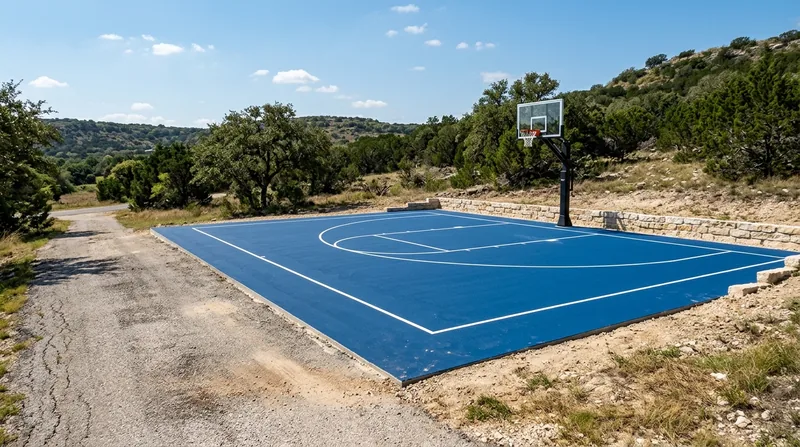




Sports Court & Path Paving in San Antonio requires a foundation that handles the ground beneath it, not just the surface above. San Antonio splits along the Balcones Escarpment: east and south, blackland prairie clay swells after storms and shrinks in dry spells, cracking any court built on a weak base. West toward the Hill Country, thin limestone and caliche demand a deep, properly compacted aggregate layer before asphalt can hold true. North and south of the city, triple-digit summers soften poorly built courts, and flash-flood storms punish any surface that does not shed water fast. A sports court or recreational path that bounces consistently and sheds water requires more than a contractor with a truck. It requires someone who understands San Antonio's ground and builds accordingly.
Why Sports Court & Path Paving Matters in San Antonio's Residential and Commercial Landscape
A tennis court, basketball court, or walking path on your San Antonio property is not just a surface. It is a hydraulic system that must shed water, a structural platform that must not crack or rut under load, and a playing surface that must remain true year after year. The ground beneath it is either working for you or against you. Blackland clay moves with moisture. Limestone and caliche are shallow. Summer heat softens asphalt over a thin base. A court built correctly will last fifteen to twenty years and play true. One built on a poor base fails within three to five years, cracks in an alligator pattern, and becomes a safety hazard and a money pit.
- We grade and compact a deep aggregate base, thicker than standard driveway construction, to anchor the court and handle San Antonio's clay and limestone.
- We finish with hot mix asphalt or a coated surface that resists rutting and maintains consistent bounce across the entire court.
- We pitch the surface to shed water in heavy rain without pooling, a critical detail in San Antonio's flash-flood corridor.
- We verify the surface is true and level with a straightedge, so every serve and baseline call is fair.
A court built right becomes an asset that lasts. A court built wrong becomes a liability within a season.
Key info: In Alamo Heights and Castle Hills, homeowners with clay-heavy lots often find that a court or path paved on the original soil will crack within two years. We excavate and replace that soil with a proper base, then build the court on top. The upfront cost is higher, but the court will not fail.
For more on how base preparation affects all asphalt surfaces, see our guide to Gravel Driveway Installation and Grading, which covers the same foundational principles.
How We Build a Sports Court or Path in San Antonio: The Right Way
Building a court is a sequence, not a shortcut. We start with the ground, not the asphalt. We measure the site, understand the soil and drainage, then build from the bottom up. A court that plays true and lasts requires compacted base, proper pitch, and hot mix asphalt laid in the right conditions. We do not rush it, and we do not cut the base to save money.
- We excavate to remove poor soil, clay, or shallow rock, and verify the depth needed by the terrain and the water table.
- We bring in clean aggregate, grade it level, and compact it in lifts until it is solid and will not move under a loaded truck.
- We set up proper drainage so water runs off the court and does not collect under the surface.
- We lay hot mix asphalt in the right weather (not in the rain, not in extreme heat), in a thickness that will not rut under play and summer heat.
- We finish the surface with a straightedge and roller to ensure the court is true and bounces evenly.
- We mark lines and edges as needed, and we do not allow play until the asphalt has cooled and cured for at least 24 to 48 hours.
This process takes longer than a quick pour, but a court built this way will not fail in five years.
Example: A residential court in Leon Valley required removal of 18 inches of clay, replacement with 12 inches of compacted limestone base, and 3 inches of hot mix asphalt. The work took four days. The court has played true for eight years with no cracking or rutting. A court poured directly on clay in the same neighborhood failed within three years.
For details on how we handle complex site conditions, visit our Sports Court & Path Paving in San Antonio (78201) page for local examples.
Methods and Finishes for Sports Courts and Paths
| Approach | Description | Best for |
|---|---|---|
| Hot Mix Asphalt (Standard) | 3 to 4 inches of hot mix over a compacted aggregate base, finished smooth and level. | Tennis courts, basketball courts, and recreational paths in San Antonio where durability and true play surface are required. |
| Coated Asphalt (Acrylic or Polyurethane) | Hot mix asphalt topped with a colored, flexible acrylic or polyurethane coating for better grip and color retention. | Courts where aesthetics matter and where an extra layer of protection against UV and water infiltration is desired. |
| Full-Depth Replacement | Complete removal of failed asphalt and base, excavation of unstable soil, and rebuilding from the ground up. | Courts on clay or shallow limestone where the original base has failed and the court cracks or ruts within a few years. |
| Overlay or Resurfacing | New hot mix asphalt laid over an existing court, if the base is still sound and the surface is not severely cracked. | Courts that are five to ten years old and show surface wear but have a solid base underneath. |
Sports Court and Path Paving Cost in San Antonio: What to Expect
A sports court or path in San Antonio starts at around $8,500 for a smaller residential court (roughly 2,500 square feet) with a standard base and hot mix finish. The price moves up quickly based on what the ground demands. A court on clay that requires excavation and a deep base replacement will cost more. A larger commercial court or a path that spans multiple properties will exceed that figure. A court that requires full-depth replacement instead of overlay will be substantially higher. The only way to know your actual cost is to have us measure the site, understand the soil and drainage, and give you a written estimate with tonnage and thickness specifications.
Factors that drive cost up include soil removal and replacement, the depth of the base required by the ground type, the size of the court, access for equipment, and whether the court is being built new or resurfaced over an existing one. A court in a tight residential lot in Terrell Hills will cost more to build than an open commercial lot in Universal City, simply because the equipment cannot move as freely. A court on limestone in the Hill Country will require less base than one on clay east of Loop 410. A path that crosses a utility right-of-way may require permits and locates that add time and cost.
We provide a free estimate within 24 hours. Call (210) 485-4679 with the address and a description of what you want to build. We will measure, assess the ground, and give you a price with a written specification of base depth, asphalt thickness, and tonnage. For a detailed breakdown of pricing across all our services, visit our pricing page.
What to Look for When Hiring a Sports Court Paving Contractor Near San Antonio
San Antonio has no state license for asphalt paving, but the City of San Antonio requires every contractor to register before pulling any permit, and the City enforces contractor standards and insurance requirements. When you hire someone to build a court or path, verify that they carry full insurance, get a written estimate with base depth and asphalt thickness specified, and ask for references from other courts they have built in San Antonio. Ask how long the asphalt will cure before play is allowed, and what maintenance they recommend. If a contractor offers a lifetime warranty on asphalt, that is a red flag. Asphalt is a material, not a manufactured product, and carries no lifetime guarantee. A honest warranty covers workmanship for one to three years.
Check whether your property is in an HOA or a deed-restricted community. Many neighborhoods in Alamo Heights, Castle Hills, Olmos Park, and Terrell Hills have architectural standards that govern the materials and colors allowed for courts and paths. Verify those rules before you build. If your court is near a property line or in the public right-of-way, San Antonio may require a permit and a setback from the street. Contact the City of San Antonio's Development Services Department or your local building office to confirm what is required on your lot.
Get at least two or three estimates. Do not choose based on price alone. Choose based on whether the contractor understands San Antonio's ground, specifies the base depth, and stands behind the work. For a free estimate from us, contact us online or call (210) 485-4679. We will be here in San Antonio when the court is finished, and we will be here if you need it repaired.
Sports Court & Path Paving in San Antonio: Pricing Guide
| Service | Price | Details |
|---|---|---|
| Residential court (2,500 sq ft, standard base) | Starting at $8,500 | Hot mix asphalt over compacted aggregate base, includes grading, pitch for drainage, and finish straightedge work |
| Court with soil replacement (clay removal and deep base) | Starting at $12,000 | Excavation of poor soil, replacement with clean aggregate, compaction, and hot mix asphalt, cost varies by depth required |
| Larger court or commercial path (5,000+ sq ft) | Starting at $15,000 | Scaled pricing based on total area, site conditions, and finish; coated surfaces add cost for color and protection |
| Full-depth replacement or complex site work | On estimate | Utility locates, permit navigation, or major excavation require on-site assessment before a firm price can be quoted |
| Estimate and site visit | Free | We measure, assess soil and drainage, and provide a written estimate with base depth and asphalt thickness specified |
Indicative pricing, the exact cost depends on square footage, finish, and site access. Free personalized estimate within 24h at (210) 485-4679.


