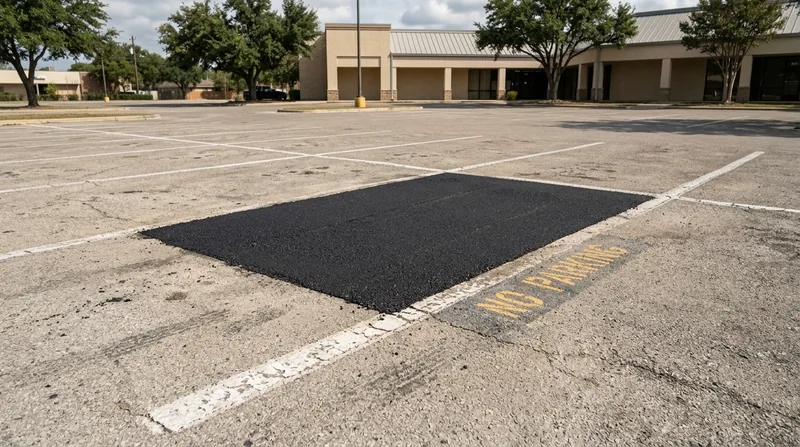




Parking Lot Repair & Resurfacing in San Antonio is a high-demand service because summer heat and heavy traffic rut asphalt long before the clay base underneath ever shifts. San Antonio's post-war commercial strips and retail centers were built on thin asphalt over marginal base prep, and thirty-plus years of triple-digit heat and loaded delivery trucks have left most lots with rutting, cracking, and surface failure concentrated in high-traffic zones. Flash-flood storms punish any lot that does not shed water fast, and the blackland clay that underlies much of the city swells after rain, then shrinks in dry spells, cracking the asphalt from underneath. We cut out the failed section, rebuild the base to proper compaction and thickness, and resurface flush so the lot holds through the next traffic cycle and the next storm. A well-maintained parking lot protects your business, keeps customers safe, and costs far less to repair and resurface than to replace.
Why Parking Lot Repair and Resurfacing Matter in San Antonio's Climate
San Antonio's heat and flash-flood cycles create two distinct failure modes in commercial parking lots. Summer temperatures above 100 degrees soften hot mix asphalt, and tires bearing the weight of delivery trucks, customer cars, and dumpsters sink ruts into the surface where water pools instead of running off. Sudden heavy rain then exploits those ruts and any surface cracks, seeping into the base, weakening the bond between asphalt and aggregate. Once rutting reaches a quarter-inch to a half-inch deep, patching alone throws money away because the rut will reform in the same traffic path within months. The second failure mode comes from the clay base itself: blackland prairie clay in east and south San Antonio swells when wet and shrinks when dry, opening alligator cracks in the asphalt above. Both problems demand repair, not sealcoating, and both respond well to targeted resurfacing or patching if caught before the base fails.
- Rutting in high-traffic zones reduces drainage and accelerates base failure, requiring removal and base rebuild rather than overlay alone.
- Alligator cracking signals base movement and demands either full-depth repair in that zone or resurfacing with a new bond layer across the whole lot.
- Potholes and edge breaks expose the base to water infiltration and grow rapidly under traffic, requiring immediate patching to prevent costlier failures.
- Proper grading and drainage pitch prevent water from pooling on the lot, extending the life of both the asphalt and the base underneath.
Addressing these issues early keeps your lot safe, maintains customer and employee confidence, and avoids the sudden closure that comes with a failed lot section.
Key info: A typical retail parking lot in San Antonio that was poured in the 1990s and last sealed or resurfaced in the early 2010s is now in the repair or resurfacing window. If your lot shows rutting deeper than a quarter-inch, alligator cracking over more than 20 percent of the surface, or standing water after rain, it needs assessment now. See the pothole repair and asphalt patching page for immediate fixes, or contact us for a free estimate on resurfacing or targeted repair.
For detailed guidance on San Antonio's parking lot permitting and stormwater rules, consult the City of San Antonio Development Services Department, which sets impervious-surface limits, drainage requirements, and parking lot design standards that affect both repair scope and cost.
How We Repair and Resurface Parking Lots in San Antonio
Our process begins with a site assessment: we measure the lot, identify failed areas, probe the base depth, check drainage pitch, and determine whether the base is still sound or compromised. For isolated failures like potholes or edge breaks, we remove the damaged asphalt, inspect and repair or replace the base as needed, and patch flush with the surrounding surface. For widespread rutting or alligator cracking, we recommend resurfacing: milling the top 1.5 to 2 inches of asphalt, grading and proof-rolling the exposed layer, and laying new hot mix asphalt over the whole lot to restore a smooth, properly pitched surface that sheds water. We provide written estimates with tonnage specs and base depth so you know exactly what the work entails.
- We survey the lot, measure failed areas, and probe the base to determine whether the problem is surface or structural.
- For isolated failures, we remove and replace the damaged section, rebuild the base to proper compaction, and patch flush.
- For widespread failure, we mill the top layer, inspect and repair the base, and resurface with new asphalt at the correct pitch and thickness.
- We verify drainage, confirm stormwater compliance with the city, and schedule work to avoid disruption to your business.
- We provide tonnage specs and base depth on every estimate so there are no surprises during the job.
Once the job is complete, new asphalt should not be sealed for the first six to twelve months while it cures and hardens. After that window, periodic sealcoating by a separate contractor can extend the life of the surface, but it is not required by us and is not included in this scope.
Example: A small office park in Alamo Heights with a 12,000 square foot lot had rutting in the customer parking zone and alligator cracking over roughly 30 percent of the surface. The base was still intact. We milled the top 1.5 inches, graded and proof-rolled the base, and laid new 2-inch asphalt with proper crown to the center. The lot was back in service within two days, and the cost was less than half what a full replacement would have run.
For larger or more complex projects, see our parking lot paving and construction page for new lot builds and full-depth replacement work.
Parking Lot Repair and Resurfacing Methods
| Approach | Description | Best for |
|---|---|---|
| Pothole and Spot Patching | Remove failed asphalt, inspect and repair the base, install new hot mix asphalt flush with the surrounding surface. | Isolated failures, potholes, edge breaks, and small areas of base damage. |
| Milling and Overlay | Remove the top 1.5 to 2 inches of asphalt, inspect the base, grade and proof-roll, then lay new hot mix asphalt across the whole lot. | Rutting, widespread surface cracking, and lots where the base is still sound but the surface is worn. |
| Full-Depth Replacement | Remove all asphalt and failed base, rebuild the aggregate base to proper compaction and thickness, and pave new asphalt. | Lots where the base is compromised, subsurface settling is visible, or drainage cannot be corrected without full reconstruction. |
| Grading and Drainage Repair | Regrade the lot to improve pitch, install or repair drainage swales and culverts, and resurface to ensure water runs off quickly. | Lots with standing water, poor drainage, or flash-flood damage where the asphalt itself is sound. |
Parking Lot Repair and Resurfacing Cost in San Antonio: What to Expect
Parking lot repair and resurfacing costs depend on the size of the lot, the extent of the failure, the condition of the base, and whether you need drainage corrections. A small pothole repair or isolated patch may run from $650 to $1,500, depending on size and base condition. A full resurfacing of a typical 10,000 to 15,000 square foot lot runs from $8,000 to $18,000, depending on mill depth, base repair needs, and whether new drainage work is required. Full-depth replacement, where the base must be rebuilt, costs significantly more and requires an on-site estimate. All estimates include tonnage specs and base depth so you know what you are paying for.
The best way to understand cost for your lot is to request a free estimate from us at (210) 485-4679. We will visit the site, assess the damage, measure the area, and provide a written quote with all the specs and details. We also recommend getting two or three estimates from local contractors so you can compare scope and price. For a detailed breakdown of typical pricing by service, see our full pricing page.
What to Look for When Hiring a Parking Lot Repair Contractor Near San Antonio
Choosing a parking lot repair contractor is one of the most important decisions a property manager or business owner makes, because a poorly done job will fail again within a year or two, and the cost of redoing the work is a total loss. A good contractor will give you a written estimate with tonnage and base depth, explain what the damage is and why the proposed fix makes sense, provide references from other San Antonio businesses, and carry full insurance. They will also help you navigate local permitting and drainage requirements, verify any HOA architectural standards if your property is in a master-planned community, and be honest about whether your lot needs patching, resurfacing, or replacement.
- Verify that the contractor is fully insured and can provide a current certificate of insurance before work begins.
- Get a written estimate that includes tonnage specs, base depth, and a clear description of what work will be done and why.
- Ask for references from other San Antonio businesses and call at least two of them to ask about the quality of the work and the contractor's professionalism.
- Confirm that the contractor understands local permitting and drainage rules and will help you navigate them if your lot requires a permit for drainage or stormwater compliance.
- If your property is in an HOA, verify with the HOA that any asphalt work meets architectural standards before you hire the contractor.
- Be wary of unsolicited door-to-door offers, contractors with out-of-state plates, requests for large cash deposits before work begins, or prices that seem too good to be true.
We have been in business since 2012, serve San Antonio and the surrounding area, and carry full insurance. You can reach us at (210) 485-4679 for a free, no-obligation estimate, and we will answer any questions you have about permitting, drainage, or the best repair approach for your lot. Contact us today to request your free estimate.
Parking Lot Repair & Resurfacing in San Antonio: Pricing Guide
| Service | Price | Details |
|---|---|---|
| Pothole and Spot Patching | Starting at $650 | Single pothole or edge break repair; cost increases with base repair depth and patch size |
| Milling and Overlay Resurfacing | Starting at $0.65 per sq ft | Typical 10,000 to 15,000 sq ft lot runs $6,500 to $9,750; base repair and drainage work add to final cost |
| Full-Depth Replacement | On estimate | Requires site inspection to assess base condition, subsurface settling, and new aggregate depth needed |
| Grading and Drainage Repair | On estimate | Cost depends on lot size, swale depth, culvert work, and whether new drainage infrastructure is needed |
| Travel and Site Visit | Included | No separate travel fee or mileage charge within San Antonio and surrounding service areas |
| Free Estimate | No charge | Written estimate with tonnage specs and base depth; response within 24 hours at (210) 485-4679 |
Indicative pricing, the exact cost depends on square footage, finish, and site access. Free personalized estimate within 24h at (210) 485-4679.


