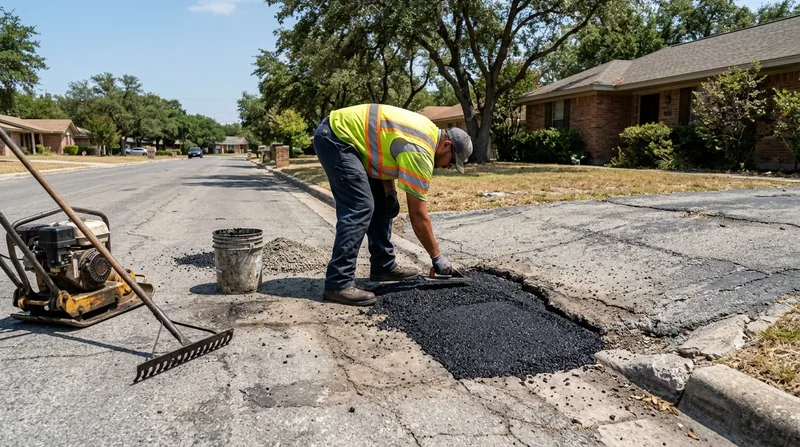




San Antonio's residential driveways face a unique challenge: the city sits at the edge of the Balcones Escarpment, where blackland prairie clay and Hill Country limestone create vastly different ground conditions across the metro area. After a heavy thunderstorm, water pools on low spots in the pavement, and the freeze-thaw cycle (though mild here) combined with triple-digit summers softens asphalt enough for traffic to punch through. The result is pothole repair and asphalt patching that starts in spring and runs through fall. We cut out the failed section, compact new aggregate base, and fill with hot mix flush to the surrounding grade. If your driveway has one or two potholes, patching buys you time. If thirty to forty percent of the surface shows alligator cracking or pooling water, the base is compromised and you need resurfacing or overlay to avoid throwing money at patches.
Why Pothole Repair Matters in San Antonio: Ground and Climate
San Antonio's potholes are not random. East and south of downtown, in neighborhoods built on blackland prairie clay, water infiltrates after a storm, the clay swells, then shrinks during dry spells and cracks the asphalt from below. North and west, toward the Hill Country, thin limestone and caliche mean the base itself is shallow, and flash-flood runoff punches through weak spots fast. The post-war ranch neighborhoods inside Loop 410 have original driveways now fifty to seventy years old, and they fail together in waves. When you see a pothole, it is a sign that water is moving under the pavement and the base is losing integrity.
- Potholes expand when water enters the base and traffic loads the pavement above.
- A small pothole ignored grows into a hazard that damages tires and suspension.
- Patching halts the spread and restores a safe, level surface.
- Base failure under a pothole means the surrounding pavement is also at risk.
- Flash-flood storms in San Antonio often create multiple potholes in the same driveway within one season.
Early patching prevents a small repair from becoming a full-depth replacement job.
Key info: San Antonio building codes and the Texas Property Code allow homeowners to patch their own driveways on private property without a permit. However, if the pothole extends into the right-of-way (the apron where your driveway meets the street), San Antonio requires a permit and inspection. Always check with the City of San Antonio Public Works Department before starting work on or near the street edge. For neighborhoods in Alamo Heights, Castle Hills, or Terrell Hills, HOA architectural standards may also govern repair methods and materials.
For guidance on permits and local rules, see the City of San Antonio official website or contact Public Works at (210) 207-3500.
How We Repair Potholes and Patch Asphalt in San Antonio
A proper patch starts with removal. We cut out the failed section in a clean rectangle or square, not just filling over the crater. We then inspect the base. If the base is solid and well-drained, we compact new aggregate, level it, and fill with hot mix asphalt. If water is pooling or the base is soft, we address drainage first so the patch does not fail again in the next heavy rain. The patch is compacted flush to the surrounding grade so water sheds away and does not pool at the edge.
- We measure the pothole and mark the cut lines to include all failed material.
- We saw-cut the perimeter and remove the broken asphalt and any soft base.
- We inspect the remaining base for moisture, ruts, or clay softness.
- We compact new aggregate base material and grade it level.
- We fill with hot mix asphalt, tamp it down, and finish flush to the surrounding surface.
- The patch is ready for normal traffic immediately, though it continues to cure for several days.
This method holds because the new material bonds to the existing pavement and the base is properly compacted.
Local example: A homeowner in Leon Valley noticed two potholes forming in the driveway apron after a May thunderstorm. We cut them out, found the base intact but compacted the aggregate tighter to improve drainage, and filled with hot mix. Six months later, no return of the potholes. The same homeowner's neighbor, who waited two months, ended up with a third pothole nearby and needed a full-depth patch of the entire apron.
For larger or more complex repairs, see our full driveway repair page.
Pothole Repair Methods and Materials
| Method | Description | Best For |
|---|---|---|
| Cold-patch (temporary) | Pre-bagged asphalt mix applied without heating, often by homeowners or emergency crews. | Temporary fixes only; does not bond well and fails quickly in San Antonio heat. |
| Hot-mix full-depth patch | We remove all failed material, inspect and compact the base, and fill with hot mix asphalt compacted to specification. | Most potholes; the standard repair that holds for years if the base is sound. |
| Saw-cut and skin patch | We saw-cut a clean perimeter, remove only the top layer of failed asphalt, and fill with hot mix. | Shallow potholes where the base is intact and only the surface has failed. |
| Base repair with new aggregate | We remove failed asphalt and base, add compacted aggregate, and fill with hot mix to restore proper pitch and drainage. | Potholes on clay soil or in low spots where water pools; prevents recurrence. |
Pothole Repair and Asphalt Patching Cost in San Antonio: What to Expect
A single pothole patch in San Antonio typically starts at $450 and depends on the size of the failed area, the condition of the base, and whether drainage work is needed. A pothole the size of a dinner plate costs less than one the size of a trash can. If the base is soft or wet, we may need to remove more material and add better aggregate, which increases the cost. Multiple potholes in the same driveway may be bundled at a better rate per patch than isolated repairs.
The best way to understand your cost is to get a written estimate with the dimensions and tonnage of material. We provide written estimates and tonnage specs so you know exactly what you are paying for. Most homeowners are surprised to learn that a patch is cheaper than they feared, especially if caught early. If your driveway shows alligator cracking or pooling water across thirty to forty percent of the surface, patching individual potholes throws money away, and resurfacing or replacement is the honest recommendation. See our full pricing page for ranges on other services.
What to Look for When Hiring a Pothole Repair Contractor Near San Antonio
The paving trade has a long history of door-to-door crews offering "leftover asphalt from a job nearby" at a price too good to be true. Avoid that entirely. A legitimate contractor is local, has a local address and phone number, and is willing to come measure your driveway and give you a written estimate before any work starts. Check that the contractor is fully insured; ask for a certificate of insurance. Get two or three estimates so you understand the market price. Call references or ask to see recent work in your neighborhood.
- Ask every contractor for a written estimate that includes the size of the patch and the tonnage of material.
- Verify that the estimate lists the depth of the patch and the base preparation method.
- Check that the contractor carries liability insurance and will provide a copy before work begins.
- Ask whether the contractor is registered with the City of San Antonio or your municipality; rules vary by jurisdiction.
- If your driveway apron touches the street, confirm the contractor understands local permitting requirements.
- If you live in an HOA community such as Alamo Heights, Terrell Hills, or Castle Hills, verify that the repair method and materials meet your architectural standards.
- Do not pay a large cash deposit upfront; a reasonable deposit is ten to twenty percent, with the balance due on completion.
- Avoid any contractor who pressures you to sign or pay before you have a written contract and an estimate.
We are fully insured and have served San Antonio since 2012. Call us at (210) 485-4679 for a free estimate.
Pothole Repair & Asphalt Patching in San Antonio: Pricing Guide
| Service | Price | Details |
|---|---|---|
| Single pothole patch (small, under 2 sq ft) | Starting at $450 | Includes removal, base inspection, aggregate compaction, and hot-mix fill flush to grade |
| Single pothole patch (medium, 2 to 6 sq ft) | Starting at $650 | Larger area requires more material and base work if the underlying aggregate is soft or wet |
| Multiple potholes or extensive patching | On estimate | Bundled patches and drainage improvements are quoted on site; written estimate with tonnage provided |
| Permit and inspection (if required by city) | Varies | San Antonio or your municipality may require a permit for work on the apron; we help navigate local rules |
| Free estimate | No charge | Response within 24 hours at (210) 485-4679; includes site visit, dimensions, and written quote |
Indicative pricing, the exact cost depends on square footage, finish, and site access. Free personalized estimate within 24h at (210) 485-4679.


