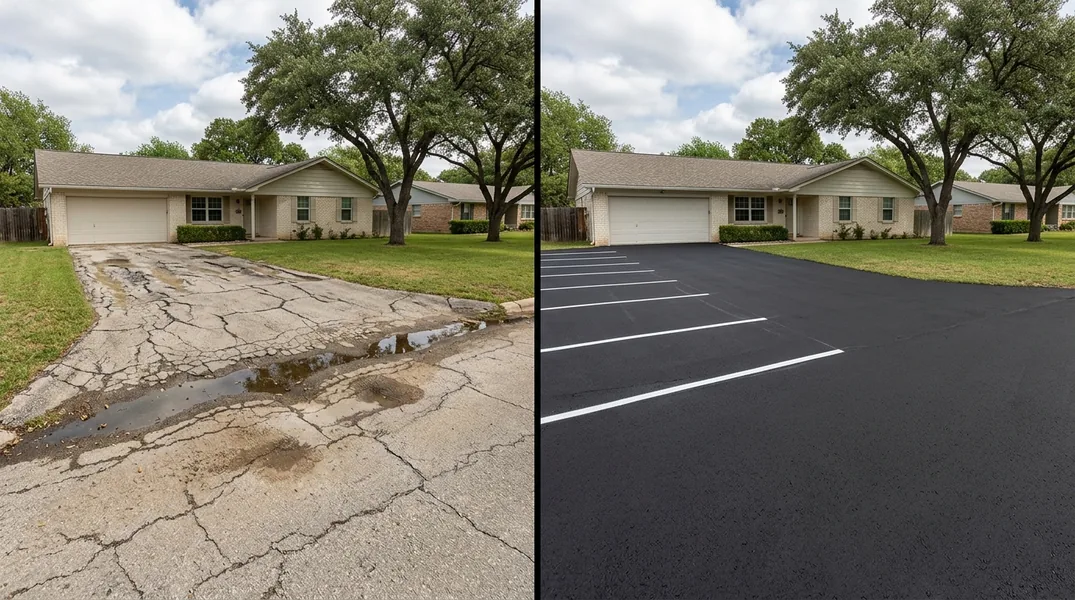
The Loop 410 Ranch Driveway Crisis: A Pattern You Can't Ignore
If you own a home in the Loop 410 ranch neighborhoods of San Antonio, you've probably noticed something troubling: multiple driveways on your street are failing at roughly the same time. Cracks spider-web across the surface. Dark stains spread from pooling water. Sections buckle and heave. And here's the frustrating part: your neighbors' driveways are experiencing identical problems, all within a few years of each other.
This isn't coincidence. The ranch-era homes built throughout the Loop 410 corridor in the 1960s and 1970s share a critical design flaw that's finally catching up with them. The original asphalt driveways were installed without proper Asphalt Driveway Paving & Installation standards for drainage, and after 50+ years of San Antonio's intense summer heat, freeze-thaw cycles, and heavy seasonal rains, the damage is becoming impossible to ignore. Understanding why this is happening is the first step toward protecting your property and making informed decisions about repair or replacement.
Why Water Pooling on Driveways Became the Norm in Older Subdivisions
The fundamental problem begins with grading and slope. When these subdivisions were developed, building codes were less stringent about drainage requirements, and contractors often prioritized speed and cost over longevity. Many of the original driveways were poured or laid with minimal slope, meaning water doesn't naturally run off toward the street or into proper drainage channels. Instead, it collects in low spots, creating what homeowners call water pooling on driveway surfaces.
This pooling isn't just an aesthetic nuisance. Standing water is asphalt's enemy. It seeps into microscopic cracks, freezes during winter, expands, and fractures the surface further. In San Antonio's climate, where we experience sudden temperature swings and occasional ice events, this freeze-thaw cycle accelerates deterioration dramatically. Additionally, water penetrating beneath the asphalt weakens the base layer and subgrade, leading to potholes, alligator cracking, and structural failure. Once one driveway in a neighborhood fails due to poor drainage, neighbors begin noticing the same patterns on their properties, creating the cluster effect seen throughout Loop 410 communities.
Understanding Driveway Drainage Solutions: French Drains and Trench Systems
The good news is that modern driveway drainage solutions can be retrofitted to aging driveways, and they're far more effective than the original designs. Two primary methods stand out: the driveway french drain and the trench drain driveway system. Both work by intercepting water before it pools on the surface and redirecting it safely away from the asphalt and your home's foundation.
A driveway french drain involves installing a perforated pipe beneath the surface, typically along the edges or at the base of a slope, surrounded by gravel and filter fabric. Water naturally percolates down through the asphalt and base layers, enters the perforated pipe, and flows away from the problem area. This method is particularly useful for driveways with slight depressions or uneven settling. A trench drain driveway system, by contrast, uses a visible or semi-visible channel (usually with a grate) that runs across the driveway's width or along its length. Water is actively directed into the trench and channeled toward a storm drain or drainage area. Both solutions address the root cause: improper water management that leads to premature failure.
The choice between these methods depends on your driveway's specific grading, your property's slope, local drainage codes, and your budget. San Antonio Asphalt Paving can assess your situation and recommend the most effective solution for your home. If you're seeing signs of water pooling or cracking, reaching out for a free estimate is the smartest first step.
Signs Your Driveway Needs Drainage Intervention Now
Waiting until your driveway completely fails is expensive and dangerous. Early warning signs indicate that drainage problems are developing and that intervention can still save your investment. Watch for persistent wet spots that don't dry within hours of rain, algae or moss growth in certain areas (a sign of constant moisture), or visible depressions where water collects. Cracks that follow patterns radiating from low spots are another red flag, as are soft or spongy areas when you walk on the surface.
If your driveway is already showing these signs, Driveway Repair becomes urgent. Depending on the extent of damage, you may need anything from localized Pothole Repair & Asphalt Patching to more comprehensive Asphalt Resurfacing & Overlay combined with proper drainage installation. The longer you delay, the deeper the damage penetrates, and the more expensive the eventual fix becomes. Many homeowners in the Loop 410 neighborhoods who acted early were able to preserve their driveways with targeted drainage solutions, while those who waited ultimately needed complete replacement.
Preventing Future Driveway Failure: Installation and Maintenance Best Practices
If you're planning new Asphalt Driveway Paving & Installation, or if you're replacing a failed driveway, proper drainage must be built in from the start. Modern standards require a minimum slope of 1 to 2 percent away from structures, which translates to roughly 1/8 inch of drop per foot of length. This gentle slope allows water to run off naturally without creating visible ruts or looking uneven. The base layer should be properly compacted and graded, and in areas prone to water accumulation, a subsurface drainage system should be installed beneath the asphalt itself.
Beyond installation, regular maintenance extends driveway life significantly. Seal-coating every two to three years protects the asphalt from UV damage and water penetration. Promptly filling small cracks prevents them from expanding into larger problems. Clearing debris and ensuring gutters and downspouts direct water away from the driveway perimeter all contribute to longevity. In San Antonio's hot climate, these preventive measures are especially important because the combination of intense sun and occasional heavy rain creates ideal conditions for accelerated deterioration if drainage isn't managed properly.
Getting Professional Help: When to Call San Antonio Asphalt Paving
Diagnosing and fixing drainage problems requires expertise. What looks like a simple crack to a homeowner might actually be a symptom of deeper grading or subsurface water issues that only a professional can identify. San Antonio Asphalt Paving has worked with countless Loop 410 homeowners facing these exact challenges, and our team understands the specific soil, climate, and development patterns that contribute to driveway failure in these neighborhoods.
If you're experiencing water pooling, visible cracks, or simply want to prevent the problems affecting your neighbors, contact San Antonio Asphalt Paving today at (210) 485-4679 or request a free estimate through our website. We'll evaluate your driveway's drainage, discuss your options, and provide clear pricing for whatever solution your property needs. Don't let your driveway become another casualty of the Loop 410 drainage crisis. Act now, and you'll protect your investment for decades to come.
Looking for a professional asphalt paving contractor in San Antonio? San Antonio Asphalt Paving responds fast for all your asphalt paving needs.
Get a Free Quote